
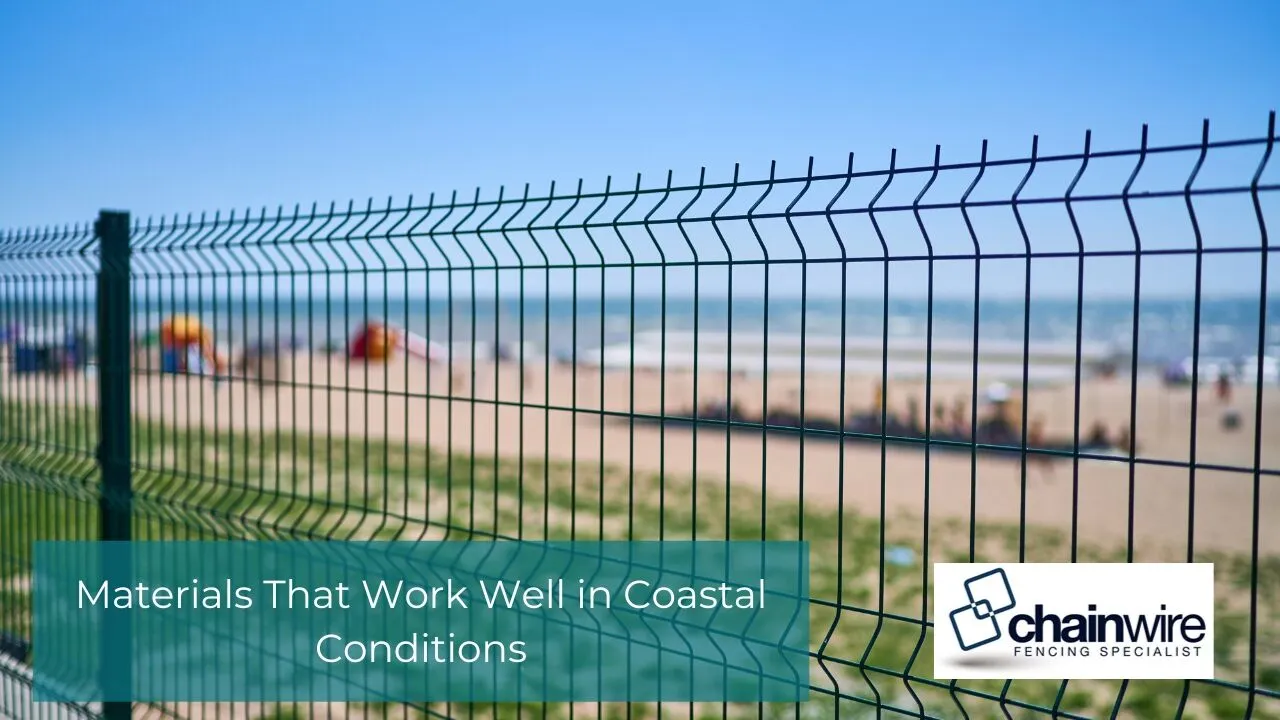
Salt air destroys fencing faster than almost anything else. Live near the coast long enough and you have seen it: rust bleeding through paint, fittings seized solid, steel posts gone soft at the base. What works twenty kilometres inland does not necessarily work on a coastal block, so material selection near the ocean is its own decision. Here is how to get it right.
Why salt air is a different problem
Ordinary corrosion is slow. Salt air speeds it up dramatically. Salt particles settle on metal and draw moisture to them, driving an electrochemical reaction that eats through coatings and into the metal beneath. The closer to the water, the higher the salt load and the faster the damage.
In Australia the coastal corrosion zone is generally defined as within about a kilometre of breaking surf or tidal water, with the most severe exposure within 100 metres. Between roughly one and five kilometres you are in a moderate zone that still warrants care, and beyond five kilometres standard materials behave normally. Estuarine sites near tidal river mouths count too, because salt travels a long way up an estuary. The Australian standards on atmospheric corrosivity and protective coatings (AS 4312 and AS/NZS 2312) set out these categories formally if you want the detail.
Materials that hold up
Aluminium is one of the best performers in salt. It does not rust; it forms a thin oxide skin that protects the metal, and salt does not break that down the way it does with iron-based metals. For residential boundary and pool fencing near the coast it is a practical, good-looking choice, and if the posts and fittings are aluminium too there are no mixed metals to cause galvanic corrosion. Its limit is strength, so it is not for high-load or agricultural spans.
Marine-grade stainless (316) is the right spec for coastal hardware. Ordinary 304 stainless pits in salt air; 316 contains molybdenum that resists chloride attack, which makes it correct for hinges, latches, screws, post bases and balustrade fittings near the water. It costs more, and in salt air the difference shows.
Colorbond Ultra is the coastal-rated version of the well-known steel product, with a heavier coating built for the severe marine zone, where standard Colorbond is not suitable. It is a common panel material on coastal homes; if you are specifying it, confirm you are getting the Ultra grade.
Treated timber survives salt better than steel does, because salt does not attack timber the way it attacks metal. Hardwoods like spotted gum, ironbark and blackbutt weather well near the coast, and treated pine resists rot and insects. The catch is mechanical: timber checks and greys, and posts set in ground eventually fail at the base, so a driven-steel or concrete-in post with timber rails often outlasts an all-timber fence.
Fibreglass and composite systems do not corrode or need painting and hold their look well, which makes them worth considering for pool and decorative work in severe zones. The trade-off is that they do not quite replicate the feel of metal or timber.
Materials to approach with care
Standard galvanised steel is the workhorse inland, but within 100 metres of the ocean the zinc coating degrades faster, so treat it as a medium-term rather than long-term solution close to the water. Beyond about 500 metres it performs adequately. Standard powder-coated steel is only as good as what is under the coating: near the coast, look for a hot-dip galvanised or zinc-primed substrate, not bare steel, because any chip lets corrosion creep under the coating.
Hardware is where people get it wrong
The right panel with the wrong hardware is wasted money. Salt attacks the small parts first, hinges, screws, brackets, latches and the wire ties on mesh fencing, so use 316 stainless or marine-grade aluminium throughout and do not mix metals, or you invite galvanic corrosion where two different metals meet. Ask "is this suitable for coastal use?" when you buy, not after the fence is up.
Practical tips
- Keep posts out of standing moisture; crown the concrete above ground so water drains away from the base, which is where posts most often fail.
- Wash the fence down with fresh water a few times a year to clear salt before it does damage. Twenty minutes with a hose adds years.
- Inspect the fixings annually, because screws and hinges corrode before panels do, and catching a failing hinge is far cheaper than replacing the gate post it takes with it.
- Do not assume a product performs the same everywhere; proximity to the water changes the answer.
The takeaway: near the coast, spec for the salt, not just the look. Within 100 metres of surf or tidal water lean on 316 stainless, marine-grade aluminium or Colorbond Ultra; out to a kilometre, aluminium and coated systems; and use 316 or marine-grade hardware throughout, whatever the panel. For a coastal metal fence, aluminium with stainless fittings is our usual recommendation. If you are unsure which zone your block sits in, ask a supplier who knows the local conditions.