
"Compliant" means a four-yearly council visit in WA, an owner-lodged certificate in Victoria, a ticking certificate clock in Queensland and no scheduled check at all in South Australia, so the first thing to know is which clock your postcode runs on.
Pool barrier rules feel like they should be one national rulebook. They are not. Whether anyone checks your pool fence, how often, and who pays for the paperwork all depend on which state you are in.
Here is the short version. In Western Australia, the council has to come to you at least once every four years. In Victoria, you have to go to them, with a fresh compliance certificate every four years. In Queensland, your certificate has a printed expiry. In South Australia, nobody is scheduled to check at all, though the barrier still has to meet the standard it was built to.
Fencing Specialist publishes this as a fencing site, not a certification service, so the practical half of this article is about the barrier itself: the gate, the gaps and the non-climbable zone. Those are what every one of these regimes eventually looks at, whatever the paperwork cycle says.
Which clock does your state run on?
| State | What triggers a check | Who does the checking | How often | Source |
|---|---|---|---|---|
| WA | A council-run inspection of private pool safety barriers | Your local government | At least once every four years | WA Building and Energy |
| VIC | You obtain a pool or spa barrier compliance certificate and lodge it with your council | The owner, lodging with council | Every four years | Building and Plumbing Commission |
| QLD | The expiry printed on the pool safety certificate | A pool safety certificate under the QBCC scheme | One year for shared pools, two years for non-shared | QBCC |
| SA | Nothing scheduled, and no inspection requirement on sale | The owner, keeping the barrier to the standard it was built to | No periodic cycle | SA Law Handbook |
| ACT (from 1 May 2028) | Sale or lease of a regulated pool or spa | A compliance certificate, required at sale or lease | Certificates issued from 1 May 2028 are valid five years | ACT Government |
| NSW | Registration, then a valid compliance certificate before the property is sold or leased. Our guide to fencing legislation in Australia covers the NSW basics. | NSW Government | ||
Four regimes, four different assumptions about who is responsible for noticing a problem.
Western Australia. Local governments are legally required to inspect private swimming pool safety barriers for compliance at least once every four years under the Building Regulations 2012. WA councils state the same cycle locally: barriers must be inspected at least once every four years. In October 2025, WA's Building and Energy urged owners to grant access after a report found property access was a key reason inspections fell overdue. Worth reading twice if you have ever left a gate padlocked and a council letter unanswered: the inspection does not go away, it just goes overdue.
Victoria. The onus sits with the owner. You must obtain and lodge a new pool or spa barrier compliance certificate with your council every four years under the Building Regulations 2018, administered by the Building and Plumbing Commission. Nobody is coming to knock. The four-year date is yours to diarise.
Queensland. The clock is printed on the certificate. A pool safety certificate is valid for one year for shared pools such as unit complexes, motels and caravan parks, and two years for non-shared private residential pools, per the Queensland Building and Construction Commission. If you own a townhouse in a body corporate with a shared pool, the shorter clock is the one that applies to that pool.
South Australia. Owners are not required to have an existing pool inspected for compliance under the Planning, Development and Infrastructure Act 2016, and there is no inspection requirement on sale. The owner is responsible for keeping the barrier compliant with the standard it was built to.
ACT. A change is coming rather than running. From 1 May 2028, compliance certificates will be required for regulated pools and spas when sold or leased, and certificates issued from that date will be valid for five years. That is far enough off to ignore today and close enough to matter if you are planning a sale late this decade.
NSW. Different shape again: owners must register the pool and, separately, obtain a valid compliance certificate before a property with a pool is sold or leased. For the NSW basics, start with our guide to fencing legislation in Australia and the NSW Government's pool rules rather than this table.
For Tasmania and the Northern Territory, we do not have verified information on a periodic inspection or certificate cycle. That is data we cannot confirm, not a statement that no cycle exists. Check with your local council before you assume either way.
Working out your own next date
The arithmetic is simple once you know which document starts the clock. In Queensland it is the issue date on the certificate. In Victoria it is the date you last lodged with council. In WA it is the last council inspection, and your council's records are the authority on that, not your memory.
No scheduled inspection is not the same as no rules
This is the point most often misread, and it matters most in South Australia. No periodic inspection requirement does not mean the barrier is unregulated. The owner still carries responsibility for keeping the barrier compliant with the standard it was built to. The difference is that nothing external prompts you to look. The prompt has to be your own.
The same logic applies in a softer way in Victoria and Queensland. A four-year or two-year cycle is the paperwork rhythm, not the safety rhythm. A latch spring fails in a week, not a quadrennium.
The four things every state's check comes back to
Whatever the certificate regime, an inspection ultimately looks at the same physical things. Walk them yourself this month with a tape measure and ten minutes.
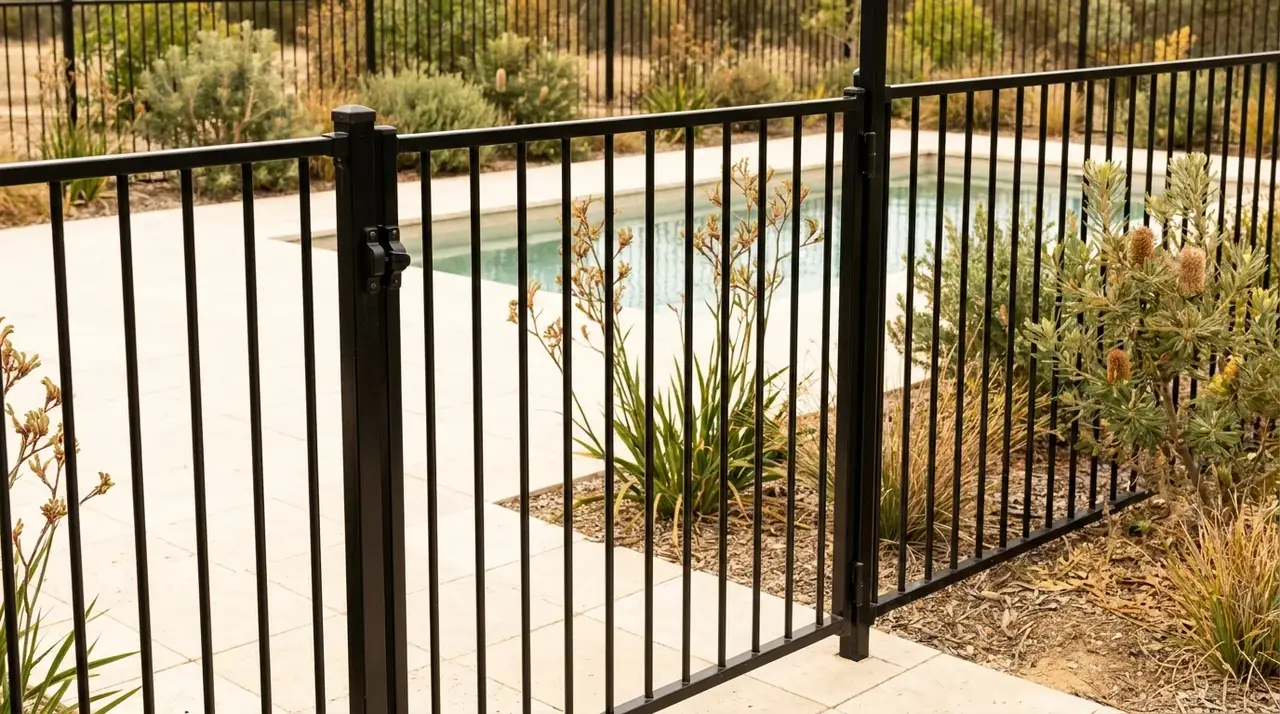
- The gate closes itself. From any starting position, released and left alone, it should swing shut without help.
- The gate latches itself. Not resting against the post. Actually engaged, so a push does not open it.
- Gaps under and through. Ground clearance under the bottom rail, and the spacing between vertical members. Soil erodes, mulch shifts, and a gap that passed four years ago may not now.
- The non-climbable zone. The clear space around the barrier where a child could get a foothold. This is the item that most often drifts out of compliance without anyone touching the fence: a pot plant, a bench seat, a pool pump cover, a tap, a shrub that grew.
Check the structure too. Loose posts, corroded fixings, a panel bowed by a fallen branch. If you are not sure whether a repair restores the original barrier or counts as a modification, ask before you cut anything: modifications can change which standard applies to the pool.
Why spring is the sensible month to look
Right now the pool is probably still covered and the yard is quiet. That is the cheap time to find a sagging gate. In January, with kids in the yard and a heatwave on, the same problem is a scramble, and in WA it may arrive as a council inspection letter you cannot easily reschedule around.
Two practical spring jobs. Move everything off the non-climbable zone before the outdoor furniture creeps back out for summer. And open and release the gate twenty times, not once: an intermittent latch is the failure that passes a quick test and fails a real one.
Your next step
If your barrier needs work rather than paperwork, that is where Fencing Specialist can help. Bring us three things: your state, the approximate age of the pool or the date the barrier was last altered, and a photo of the gate and the fence line including whatever sits within a metre or so of it.
Our guides cover fencing types, materials and rules across Australia, and quote enquiries are routed to our Chainwire Fencing Specialist team in Newcastle. Call 02 4023 5416 or send an enquiry through fencingspecialist.com.au and tell us what the gate is doing.
For certificates, inspections and register entries, your council or your state regulator is the authority, and the links below are the primary pages for each state.
Sources
- WA Building and Energy, Local governments pulling ahead on pool inspections: https://www.wa.gov.au/government/announcements/local-governments-pulling-ahead-pool-inspections
- Town of East Fremantle, Swimming pools and spas: https://www.eastfremantle.wa.gov.au/development/building/swimming-pools-and-spas.aspx
- Building and Plumbing Commission (Vic), Pool and spa registration requirements: https://www.bpc.vic.gov.au/home-owners/home-renovation-and-building-essentials/swimming-pools-and-spas/pool-and-spa-registration-requirements
- Queensland Building and Construction Commission, Inspect and certify a pool: https://www.qbcc.qld.gov.au/home-owner-hub/swimming-pools/inspect-certify-pool
- Legal Services Commission of SA, Law Handbook, swimming pool safety: https://www.lawhandbook.sa.gov.au/ch31s02s05.php
- ACT Government, Home swimming pool safety reforms: https://www.planning.act.gov.au/planning-projects/building-regulatory-system/home-swimming-pool-safety-reforms
- NSW Government, Pool owner obligations: https://www.nsw.gov.au/housing-and-construction/building-or-renovating-a-home/pools-and-pool-safety/owner-obligations