
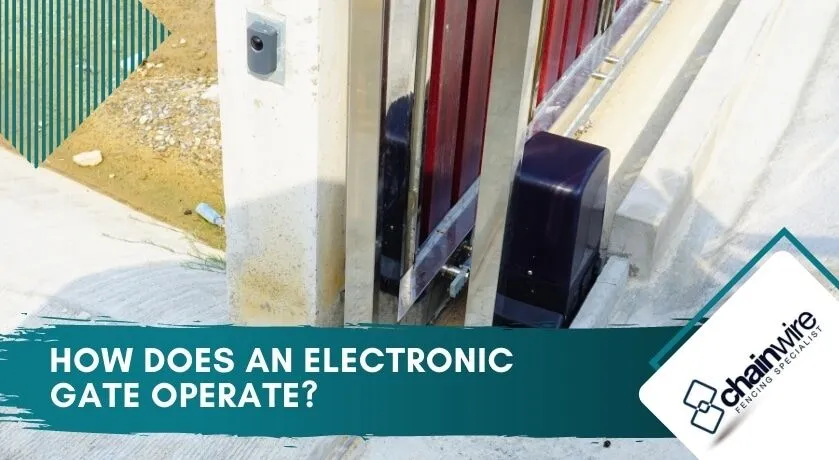
Alongside cameras, smart locks and access control, more businesses and homeowners are fitting electronic gates. The appeal is simple: full control over who comes and goes. Every vehicle has to pass through the gate, which gives you a checkpoint where before there was just an open driveway. Like anything, they come with trade-offs, so here is the honest picture.
How an electronic gate works
An electronic gate is two parts: the gate itself, and the operator that drives it. The gate can be built from chainwire, welded mesh or solid steel infill, usually matched to the surrounding fence so the whole run looks of a piece. The operator is the powered mechanism that opens and closes it, driven by electricity through hydraulics, chains or gears. Pair the gate with cameras and, on higher-security sites, a person on access control, and you have a system rather than just a barrier.
The three main types
Sliding gates
Sliding gates, also called rolling or V-track gates, run on a wheeled track across the opening using a chain-and-pulley drive. They are among the most common types across many industries and open under remote control. The thing to watch is the track: stones and debris can jam the wheels, and rollers can wear or rust over time, so they suit sites where the track can be kept clear.
Cantilever gates
Cantilever gates look like sliding gates but carry no ground rollers. Instead the gate is counterbalanced and slides along rails set on the fence, so nothing runs on the ground to jam or seize. That makes them more durable and reliable for heavy-duty and industrial use, at a higher build cost.
Swing gates
Swing gates work like a large door, hinged on one side and swinging through up to 90 degrees, as a single or double leaf. They are simple and robust, but the swinging arc needs clear space and safety measures so an approaching vehicle or pedestrian is never in the path.
The benefits
Controlled access. Only authorised people get in. Codes, cards or scanners screen everyone, and you decide who has credentials.
Better security and peace of mind. A limited, monitored entry point is a real deterrent and protects the people and assets inside.
Convenience. Nobody has to leave a post to open the gate, which matters in bad weather and lets security staff keep their eyes on who is actually entering.
Keeps unauthorised vehicles out. Car parks are a common way people slip onto private ground; a gated entry closes that off.
Presence. A well-built automated gate looks the part and signals that a business takes security seriously.
The downsides
Cost. The gate, the operator and the ongoing maintenance all cost more than a manual gate. It is an investment, and worth pricing properly.
Reliance on power. Electric gates need electricity, so a blackout can trap people in or out unless you fit a battery backup, standby generator or solar system. On any serious site, plan for the power failing.
They need a professional. Installation and servicing should be done by someone who knows the mechanism. A poorly set-up automated gate is both unreliable and a safety risk.
Safety is not optional
An electronic gate is a heavy object that moves under power, so it has to be treated as machinery. Australian Standards set out how these gates should be built and installed to operate safely, and the safety features are what stop a gate crushing or trapping someone. A few essentials:
- Fit safety devices between the moving gate and fixed points like the gatepost, so there is nowhere a person can be crushed.
- Set the safety beam sensors correctly so the gate detects anyone in the opening and stops.
- Keep the power supply stable and uninterrupted.
- Run a safety check about once a week, and if a mechanism is faulty, lock the gate fully open or fully shut until it is repaired.
- Older gates installed before modern safety standards often lack these fittings and should be upgraded.
Cutting corners on installation or design to save a bit up front is exactly where injuries happen, so this is the part to get a professional to sign off.
Which businesses gain the most
Almost any property benefits, but a few get outsized value. Warehouses hold a lot of stock behind doors that stand empty for stretches, so a gated, credentialed entry is a genuine upgrade. Retail and distribution sites carry high-value goods that a manually manned gate cannot properly protect. Banks and cash-handling businesses need layered access control as a baseline. Any site that is unoccupied for windows of the day, or that holds assets worth planning a break-in for, is a candidate.
The takeaway: an electronic gate buys you controlled, convenient, monitored access, at the cost of a bigger budget, a dependence on power you must back up, and a real duty to install and maintain it safely. Match the gate type to your traffic and site, plan for the power failing, and have it fitted by someone who knows the safety standards. When you are weighing it up for a commercial site, Chainwire Fencing Specialist can design and fabricate the gate and fence as one system.