
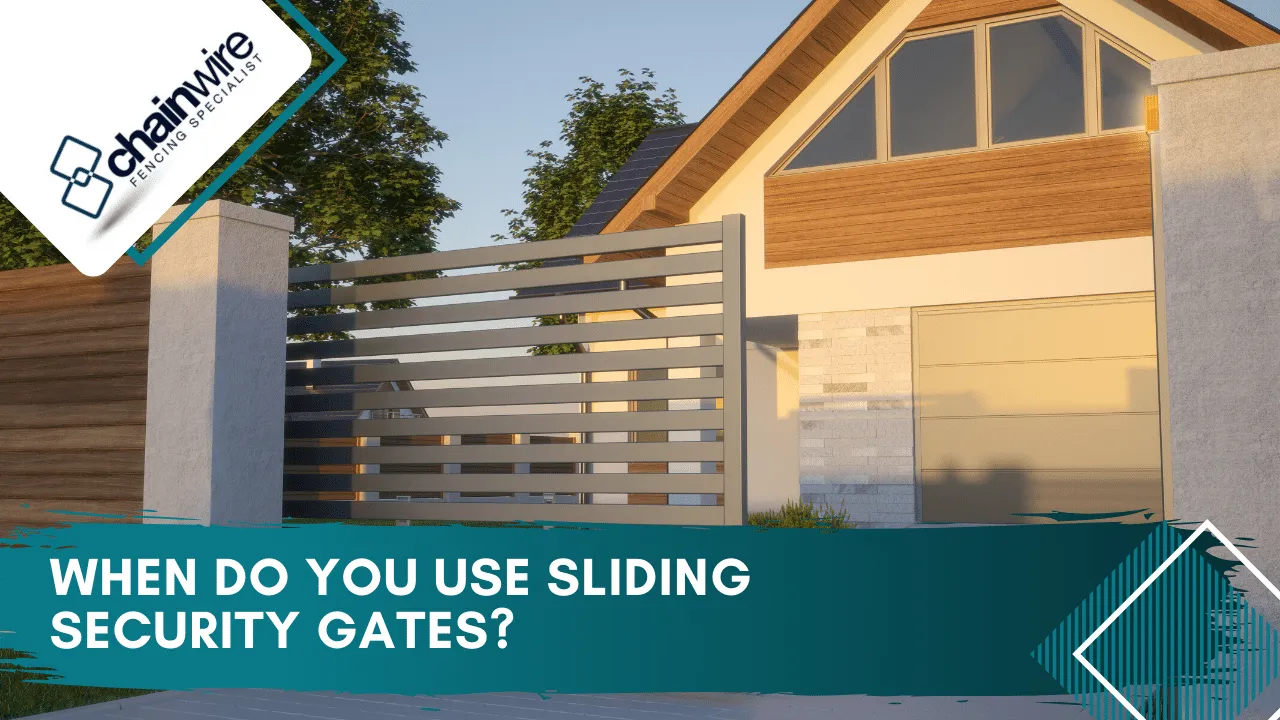
Sliding gates are popular for good reason. They look sharp, they open smoothly, and they often carry better security features than a traditional swing gate. But they are not the right answer everywhere. Understanding when a sliding gate shines, and when it will fight you, is worth doing before you commit.
How a sliding gate works
A slide gate mounts on the inside of the fence and moves sideways rather than swinging out. It runs one of two ways: on rollers along a ground track, or as a cantilever suspended off support posts with no track touching the ground. Both glide well when set up right. Because there are moving parts along a rail or bearing system, sliding gates do ask for a little more maintenance than a plain swing gate.
When a sliding gate is the right call
When space is tight. This is the sliding gate's home ground. A swing gate needs a clear arc to open into; a sliding gate just retracts along the fence. On a short driveway, a small parking area or anywhere a swinging leaf would foul a car or a wall, sliding is the obvious pick. It leaves the whole opening clear with no clutter.
When the ground is even. Sliding gates, especially track-mounted ones, want a level run. On an uneven surface a track gate will drift towards slammed-shut or fall-open on its own. If your ground is not level, a cantilever gate solves it neatly, because it runs suspended above the ground and is not tied to a floor track.
When to think twice
When there is a lot of dust and debris. Ground tracks collect dirt, wet leaves and grit, and a clogged track means a gate that jams or wears fast. Larger debris caught in the track can stop the gate outright. Cantilever gates avoid the ground track but still have a bearing system that dust can foul over time. On a dusty rural block, talk it through with a fencing contractor before defaulting to a slider.
In the depths of a cold snap. Metal contracts in the cold, which adds friction, and while Newcastle rarely sees snow, a hard cold morning can make a track gate sluggish. It is rarely a dealbreaker locally, but it is worth knowing that lubrication and setup matter more in the cold.
Track versus cantilever, in short
| Track (ground rail) | Cantilever (suspended) | |
|---|---|---|
| Best ground | Level, sealed | Handles uneven ground |
| Debris tolerance | Lower, track clogs | Higher, no ground track |
| Relative cost | Usually lower | Usually higher |
Where sliding gates suit best
Sliding security gates earn their place on:
- Residential entrances that need every metre of driveway
- Office, warehouse and industrial entries
- Commercial and business frontages
- Schools and other educational facilities
- Pool and sporting facility access
If a sliding gate fits your site, a contractor's sliding security gates work will show you the track and cantilever options built to hold up locally. Match the gate type to your ground and your dust, and it will run smoothly for years. Get that pairing wrong and you will be out there clearing the track every other week, so it is worth getting right the first time.