
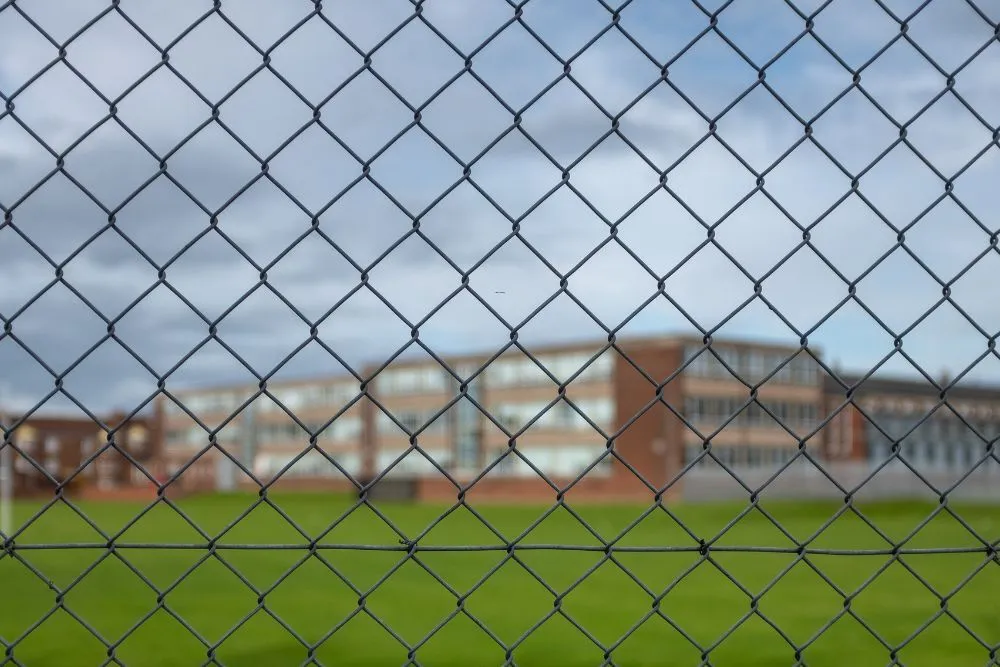
A school fence does more than mark a boundary. It controls who gets on and off the grounds during the day, keeps younger children away from roads and car parks, and separates play areas from delivery zones and plant. On a childcare site the same fence carries a duty-of-care weight: supervised, hard to climb, and gap-free along the base.
What the fence is usually made of
Most school and childcare fencing is chainwire or welded mesh, generally PVC coated in black or green so it reads as tidy rather than industrial and stands up to constant contact. Heights are chosen to suit the risk. A play boundary sits lower than a secure perimeter, and a preschool line is built with no footholds and self-closing, self-latching gates.
The parts that make it secure
- Perimeter fencing around the outer boundary to stop casual entry after hours.
- PVC coated mesh in black or green for wear resistance and a cleaner look.
- Controlled and alarmed gates so staff manage entry and get alerted to forced or out-of-hours access.
- Sport enclosure fencing to keep balls in and separate active play from the rest of the grounds.
- Indoor storage cages for equipment and restricted materials.
Standards and approvals
School fencing answers to more than one authority. Installation sits under SafeWork NSW rules for safe work and secure construction, NSW Department of Education guidance on school safety and security, and local council rules on height, placement and design. Childcare boundaries also carry supervision and climbability requirements, so gate hardware and base clearances matter as much as the fence line itself.
Working out what a site needs
Start with the access points: how many there are, who uses them, and when. Then map the risk, the roads, car parks, water and plant, and the zones that should never be reachable by a child. Height, mesh aperture and gate type follow from that, not the other way around.
Who builds it
School and childcare fencing is built by the Newcastle crew behind Chainwire Fencing Specialist, working across Newcastle, Lake Macquarie and the Hunter since 2004. These jobs run to term timelines and site inductions, so they get planned around access and disruption rather than dropped in. To talk through a site, contact the team.
Settle the access and risk map before you pick a height, and put the gate hardware, self-closing, self-latching and correctly rated, at the top of the list. That is where school fencing usually fails first.