
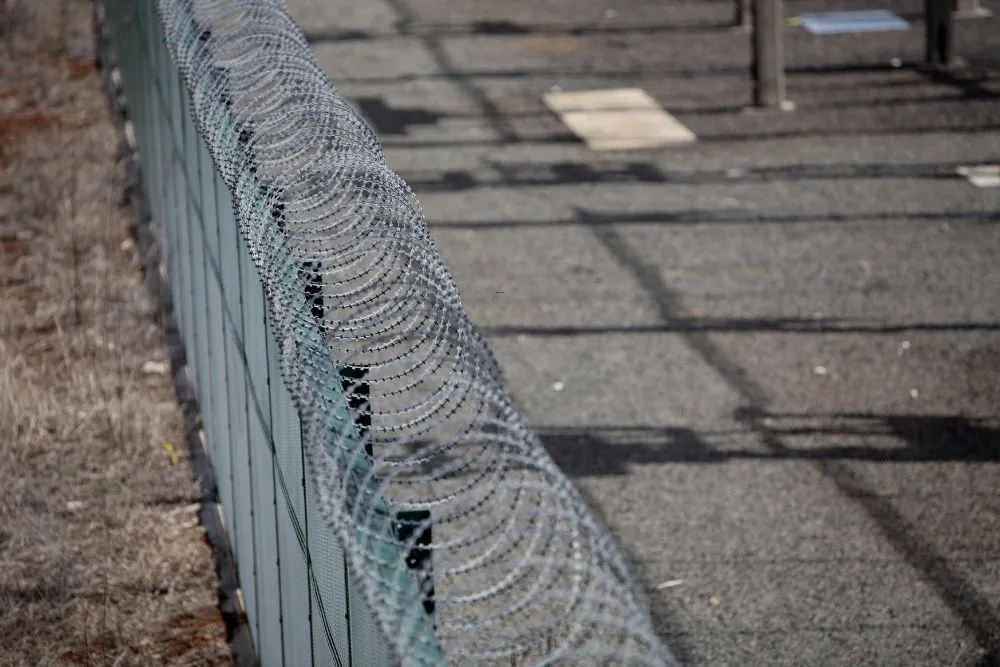
Security fencing manages movement and prevents breaches on sites where an ordinary boundary fence is not enough. Industrial yards, warehouses, schools and commercial property all rely on it to restrict access, protect assets and support whatever monitoring is already in place. The fence is only as strong as its weakest point, so the whole line, and every gate in it, has to hold to the same standard.
What a security fence is made of
- Chainwire or welded mesh for the perimeter run, galvanised or PVC coated to suit the site.
- Steel where a stronger, harder-to-cut barrier is warranted.
- Barbed or razor toppings to add height and deter climbing at the fence line.
- Controlled and alarmed gates for managed entry and alerts on forced or after-hours access.
- Indoor storage cages to secure equipment and restricted materials inside the building.
Matching the fence to the risk
Not every site needs the same fence. A low-risk boundary is well served by galvanised chainwire and a good gate. A high-value or high-risk yard justifies welded mesh, anti-climb detail and gates tied into detection. The trick is to spend where the risk actually is, the entry points and the vulnerable corners, rather than gold-plating the whole run.
Standards and approvals
Security fencing is built against Australian security standards for controlled sites, SafeWork NSW requirements for safe installation, and local council rules on height and placement. For chain-link and mesh fencing the relevant material and installation guidance sits with Standards Australia. Meeting these keeps a site both secure and compliant.
Where it gets used
Correctional and detention sites, schools and childcare, warehouses and industrial yards, and any commercial property holding stock or plant worth protecting. Each one weights the same parts differently, which is why the assessment comes before the quote.
Who builds it
Security fencing is fabricated and installed by the Newcastle crew behind Chainwire Fencing Specialist, working across commercial and industrial sites since 2004, with fabrication done in their own Toronto workshop. To scope a perimeter, contact the team.
Walk the line and find your weak points first, the gates, the corners and the low spots, and put the budget there. A perimeter is only as secure as the easiest way through it.