
Railways move people and freight efficiently, and a small problem on the tracks can carry enormous cost, and real danger, for the public. That is why access to a rail corridor is tightly controlled, and why fencing along it is not optional infrastructure but a core part of keeping people safe.
Keeping people off the tracks
The plain purpose of rail corridor fencing is to keep people out of a space that only authorised, trained personnel should enter. People do still find their way onto live tracks, with tragic results, and a secure boundary is the first and simplest defence against it. Only stations should offer public access to trains; everywhere else the corridor needs to be sealed off. A well-built fence removes the easy opportunity and makes the risk far less likely.
Guiding safe crossings
Where pedestrians do need to cross a line, fencing is what channels them to the right place. A stable, continuous barrier ensures people cross only at designated points and do not wander onto the tracks, which is exactly where injuries and fatalities happen when a safe path is not provided. Good fencing also gives clear warning to everyone approaching, and helps protect rail operators from liability where signage alone would fall short.
Containing problems in an emergency
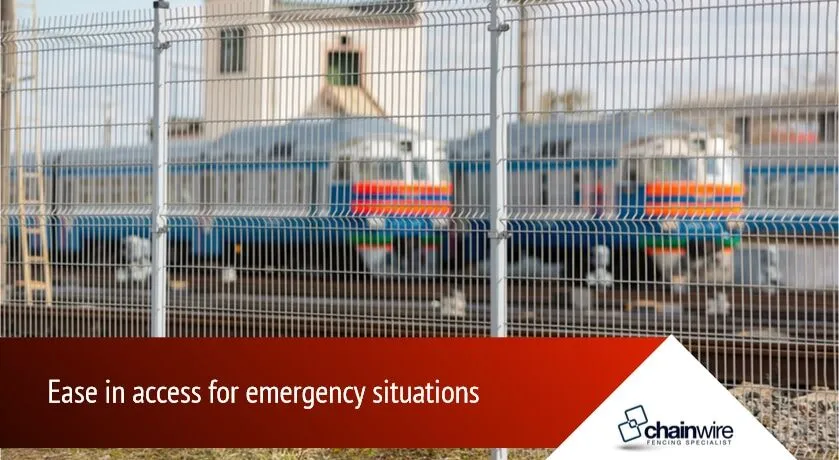
When something does go wrong on a line, a mechanical failure, a fire, an evacuation, fencing helps manage it. It directs passengers leaving a train towards safety and away from adjacent tracks and hazards, and in rural areas where dry vegetation can carry a fire, a corridor boundary helps contain the spread. In a situation where seconds and clear direction matter, a defined, fenced edge is quietly doing important work.
The same logic beside a road
Where a rail line, or any property, runs alongside a busy road, fencing protects in both directions. On rural land near a highway, a strong chainwire barrier keeps stock off the carriageway, so animals do not stray into traffic, and if a vehicle leaves the road, the fence helps cushion the impact and shields animals and property behind it. Because chainwire is relatively affordable to repair, a boundary that takes an occasional knock does not become a major expense. The see-through mesh also lets a landholder spot trouble, a straying animal, an intruder, before it becomes a crisis.
Why the crew matters as much as the fence
Fencing a rail corridor is not ordinary fencing work. It happens in a live, hazardous environment under strict safety controls, which is why the crews who do it are trained and ticketed to work on the railways. That combination, corridor-grade fencing built by people cleared to be there, is what these projects require, and it is not something every fencing contractor can offer.
The takeaway is straightforward. Rail corridor and roadside fencing is safety infrastructure first and a boundary second. Whether it is keeping the public off a live line, guiding a safe crossing or keeping stock away from traffic, the fence is doing a job where getting it right genuinely matters.